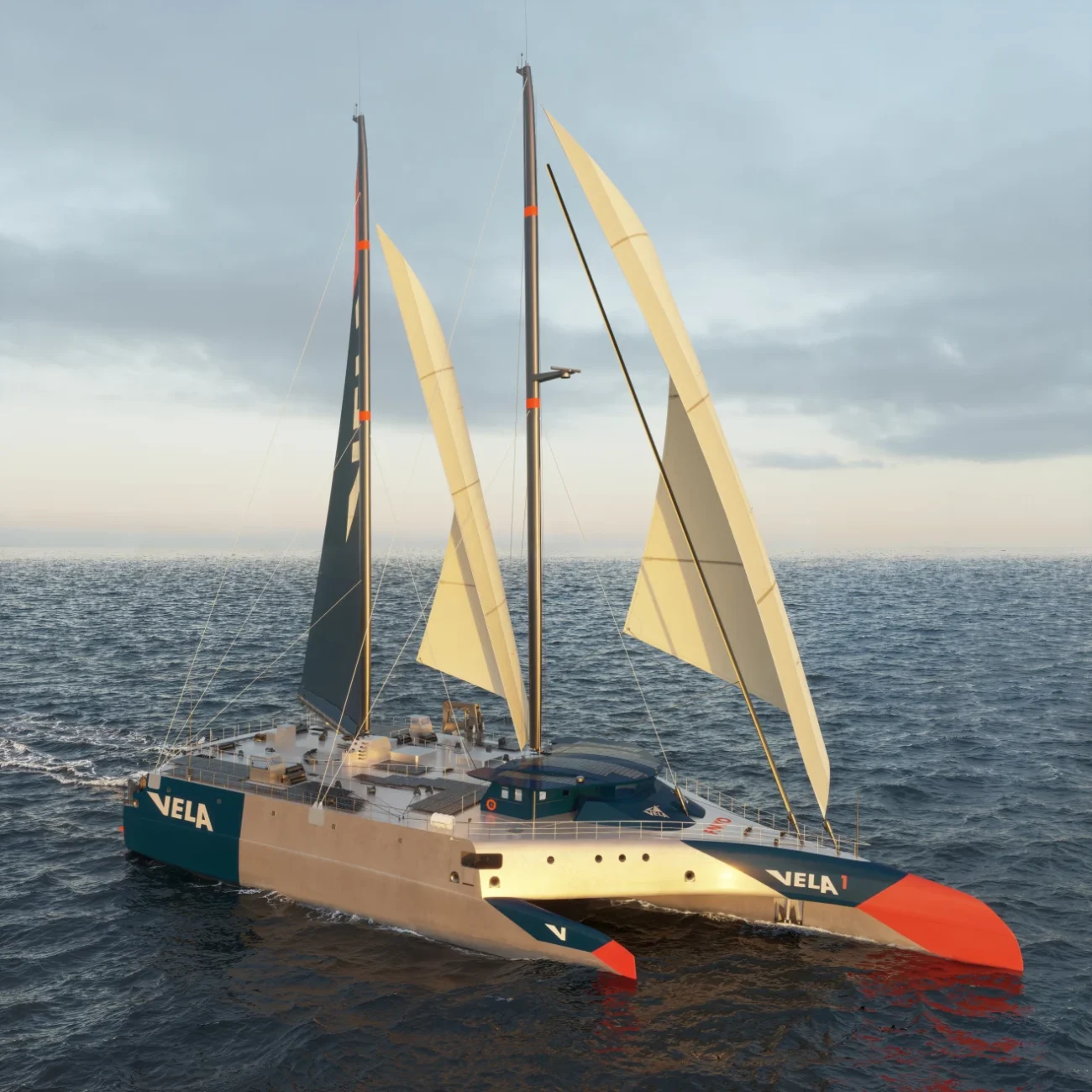
A 100% wind-powered cargo ship that can dramatically cut transatlantic shipping times and carbon emissions, according to its operator, could launch in early 2027.
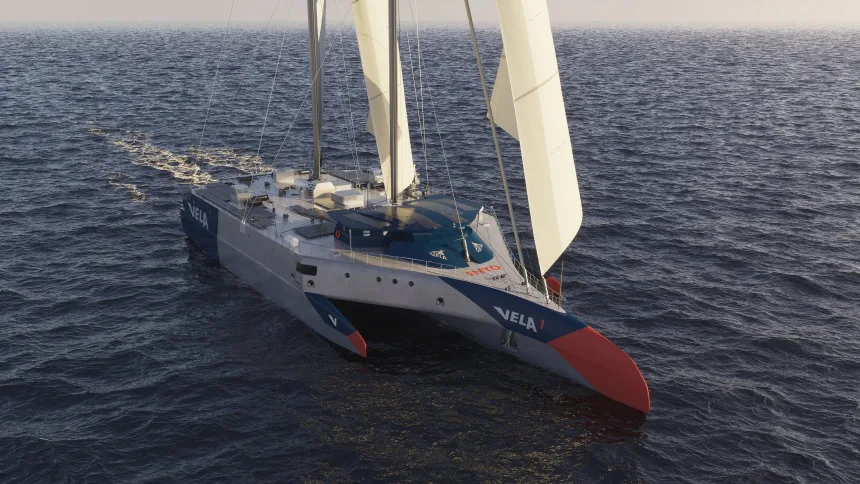
French company Vela will run a service between France and the US with its custom-made seacraft. The 220-foot (67-meter) long, 82-foot (25-meter) wide vessel will be able to transport just over 400 metric tons of cargo, and was designed with the input of Vela cofounder François Gabart, a professional yacht racer and the fastest sailor to circumnavigate the globe solo.
The trimaran, with two smaller hulls on either side of a central hull, will be propelled by sails extending 200 feet (61 meters) above the waterline, with onboard power for living and working quarters, plus temperature-controlled cargo holds, provided by solar panels and two hydro generators. Vela says it will travel at an average speed of 14 knots — equivalent to the speed of a modern container ship — between New Jersey and Normandy or Bordeaux, France.
The vessel can hold approximately five times the capacity of a cargo plane, says the company. Vela positions its services somewhere between conventional sea and air freight: quicker than sea freight, slower than air freight, and with much lower emissions than either.
The company says it intends to price its services between the cost of conventional sea and air freight. It is pitching companies that would normally use air freight to move high value-added goods (such as pharmaceuticals and luxury cosmetics), and are looking for greener alternatives with comparable quality control.
A life cycle assessment, conducted by Vela and climate consultancy group Carbone 4, calculated carbon emissions from the North Atlantic crossing would be up to 96% less than a conventional container ship, and up to 99% less than air freight.
The trimaran could also be less disturbing to wildlife than conventional sea freight. Engine-powered cargo ships can produce noise over 190 decibels (louder than a jet aircraft taking off). Underwater noise pollution masks whale, dolphin and fish communication, disorients animals and disrupts hunting, according to the International Fund for Animal Welfare.
By using sails, Vela said “underwater noise will be almost completely eliminated,” with its vessel only using auxiliary propulsion for low-speed maneuvering in port to meet safety requirements.
“Clients no longer want to choose between speed, reliability and sustainability. They want all three at once,” said CEO and co-founder Pierre-Arnaud Vallon.
Although Vela’s vessel doesn’t reach speeds higher than conventional cargo ships, the company touts swift delivery times by taking a holistic view of cargo travel. The trimaran will take a direct route from the US to France and back, not stopping at multiple ports to reach capacity, unlike much sea freight on the eastbound route, explained managing director and co-founder Michael Fernandez-Ferri.
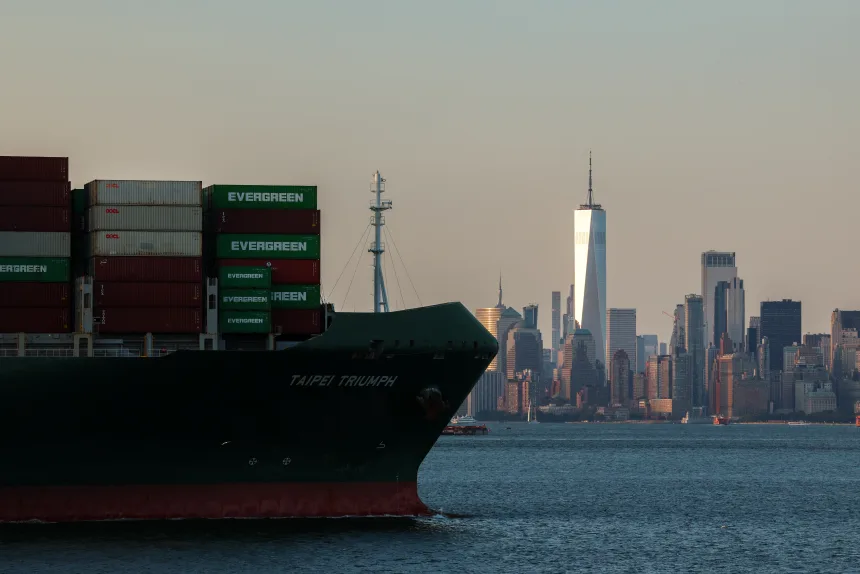
The vessel carries around 100 times less than a conventional container ship, meaning loading and unloading times are shorter, he added, and its size means it can enter secondary port terminals that have less congestion and quicker docking times.
North Atlantic wind data — much of it gleaned from ocean racing — as well as a ship designed for both light and very strong wind conditions will help it meet delivery times, said Fernandez-Ferri.
With everything factored in, Vela says it can load, cross the Atlantic and unload in 15 days. Fernandez-Ferri claimed that compared to conventional ocean freight, “we’re two times faster on the westbound (journey) to the US, and up to four times faster on the eastbound.” Compared to air freight, Vela calculates its service will be one week slower.
Decarbonizing freight
Ocean freight has proved one of the hardest modes of transport to decarbonize. The shipping industry accounts for around 3% of global greenhouse gas emissions, according to the International Maritime Organization (IMO), thanks largely to its reliance on fossil fuels.
Members of the IMO agreed in 2023 that the shipping industry would reach net-zero emissions by around 2050. Implementing a plan has proved tricky for the UN-backed body. Last October, a vote to introduce new fuel standards and a carbon tax — that would encourage emissions reductions and raise funds for climate action — was delayed for 12 months following a campaign by the US, after President Donald Trump called the proposal a “scam tax.”
